Kaspa Leads Proof-of-Work Speed Race as BlockDAG Architecture Redefines Scalability
Block time is an important metric for evaluating blockchain performance, describing the target or average interval between successive blocks. Shorter block intervals can increase the frequency of block production and may reduce transaction inclusion delays, although the time required for a transaction to achieve finality depends on the network’s consensus mechanism and the number of confirmations required. Comparing block times provides a useful starting point for understanding how different blockchain architectures handle transaction processing and ledger updates.
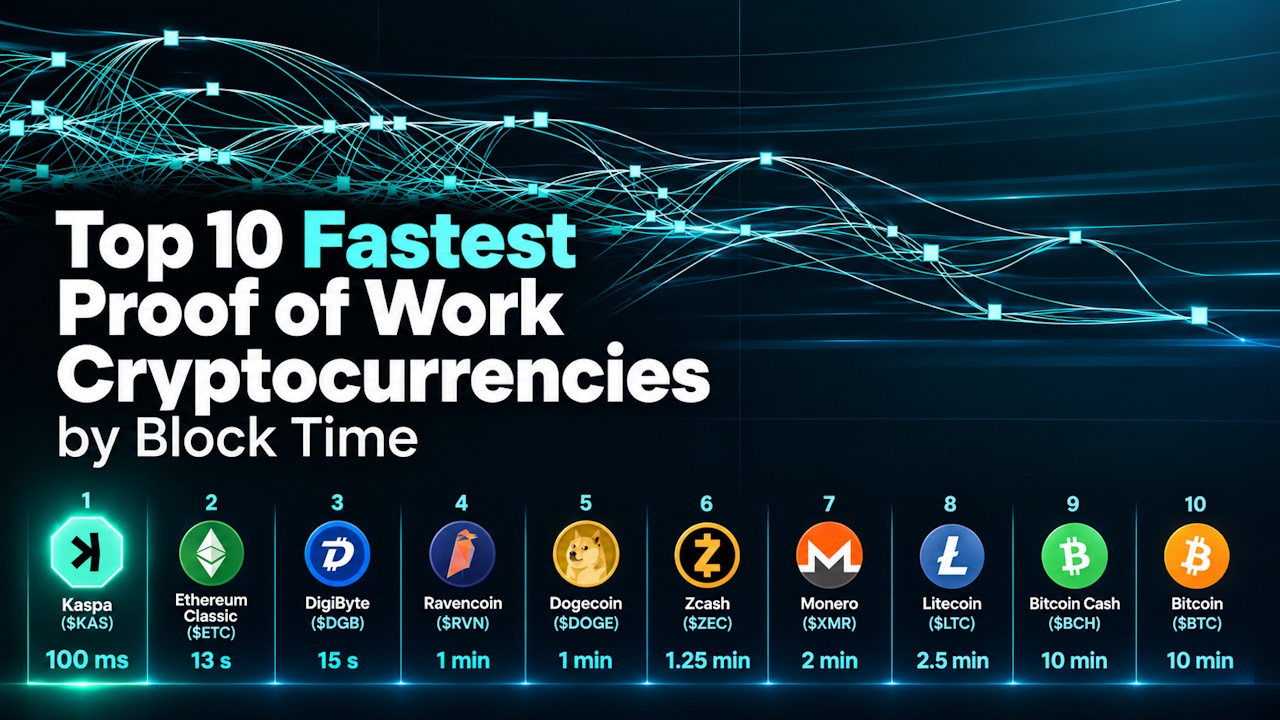
Here is the ranking of the top 10 fastest proof-of-work cryptocurrencies by target block time:
- Kaspa ($KAS) - 100 ms
- Ethereum Classic ($ETC) - 13 seconds
- DigiByte ($DGB) - 15 seconds
- Ravencoin ($RVN) - 1 minute
- Dogecoin ($DOGE) - 1 minute
- Zcash ($ZEC) - 1.25 minutes
- Monero ($XMR) - 2 minutes
- Litecoin ($LTC) - 2.5 minutes
- Bitcoin Cash ($BCH) - 10 minutes
- Bitcoin ($BTC) - 10 minutes
Kaspa’s 100-millisecond target, achieved after the Crescendo upgrade, equates to ten blocks per second. This is not a marginal improvement; it is orders of magnitude faster than the next contenders and dramatically faster than Bitcoin’s deliberate 10-minute cadence.
Traditional linear blockchains face a fundamental constraint that has limited their performance for more than a decade. When blocks are produced too frequently relative to network propagation delays, multiple valid blocks often appear at roughly the same time. In a classic chain, only one of those blocks can be accepted; the others become orphans. High orphan rates waste mining work, dilute security, and force protocol designers to keep block intervals long enough that collisions remain rare. The result is an inherent trade-off: faster blocks reduce security, while slower blocks throttle throughput and increase confirmation latency. Scaling block size instead of frequency creates its own propagation and centralization pressures. In short, traditional blockchains cannot raise throughput securely without compromising the very properties that make proof-of-work valuable.
Kaspa’s blockDAG architecture directly addresses this limitation. Rather than forcing every block to reference a single parent, each new block can reference multiple parents. Parallel blocks are retained rather than discarded, and a consensus protocol orders them into a coherent ledger. The current protocol, GHOSTDAG, builds on ideas first explored in the GHOST (Greedy Heaviest Observed Subtree) protocol proposed by Yonatan Sompolinsky and Aviv Zohar. GHOST itself influenced early Ethereum design discussions and later appeared in modified form (including LMD-GHOST) within Ethereum’s proof-of-stake consensus. Kaspa generalizes the approach for a full directed acyclic graph of blocks, allowing the network to absorb high rates of parallel production while still selecting a secure, ordered history.
Looking further ahead, the planned DAG KNIGHT upgrade aims to remove a remaining limitation of GHOSTDAG. The current protocol relies on a fixed security parameter derived from an assumed upper bound on network latency. DAG KNIGHT is designed to be parameterless: it continuously infers actual network conditions from the structure of the DAG itself and adapts accordingly. This removes the need for a hardcoded interval or worst-case latency assumption. Research targets confirmation characteristics on the order of 40 milliseconds in the nearer term, with a longer-term trajectory toward 100 blocks per second (approximately 10 ms average intervals). Because the protocol responds to measured conditions rather than a fixed schedule, block production and confirmation speed can improve automatically as network infrastructure advances, without requiring repeated hard-coded parameter changes.
Faster, adaptive block production carries practical benefits beyond raw speed. Shorter intervals and more responsive finality compress the window available for certain forms of extractive behavior, including some classes of maximal extractable value (MEV) strategies that rely on predictable delays or mempool observation time. When honest blocks arrive continuously and ordering adapts to real network latency, the economic opportunities for front-running and related attacks become more constrained while overall confirmation latency drops.
Kaspa already demonstrates that proof-of-work need not remain slow to remain secure. Its blockDAG foundation, informed by the same research lineage that produced GHOST, has delivered live performance far beyond traditional chains. The forthcoming DAG KNIGHT work seeks to make that performance more adaptive still. For users and developers seeking energy-based security with internet-speed responsiveness, the gap between Kaspa and the rest of the proof-of-work field is both measurable and widening.